The Specter of Authoritarianism and the Future of the Left: An Interview With Henry A. Giroux

Henry Giroux, author of “Pedagogy of the Oppressed” and one of the founding theorists of critical pedagogy, was interviewed recently by CJ Polychroniou of “Truthout”.  As part of the discussion, Giroux spoke about the impact felt at universities that are increasingly turning toward corporate management models and marketization.

“The increasing corporatization of higher education poses a dire threat to its role as a democratic public sphere and a vital site where students can learn to address important social issues, be self-reflective and learn the knowledge, values and ideas central to deepening and expanding the capacities they need to be engaged and critical agents. Under neoliberalism, higher education is dangerous because it has the potential to educate young people to think critically and learn how to hold power accountable. Unfortunately, with the rise of the corporate university which now defines all aspects of governing, curriculum, financial matters and a host of other academic policies, education is now largely about training, creating an elite class of managers, and eviscerating those forms of knowledge that conjure up what might be considered dangerous forms of moral witnessing and collective political action.

Any subject or mode of knowledge that does not serve the instrumental needs of capital is rendered disposable, suggesting that the only value of any worth is exchange value; the only pedagogical practice of any value must be reduced to a commercial transaction. The corporate university is the ultimate expression of a disimagination machine, which employs a top-down authoritarian style of power, mimics a business culture, infantilizes students by treating them as consumers, and depoliticizes faculty by removing them from all forms of governance. As William Boardman argues, the destruction of higher education “by the forces of commerce and authoritarian politics is a sad illustration of how the democratic ethos (educate everyone to their capacity, for free) has given way to exploitation (turning students into a profit center that has the serendipitous benefit of feeding inequality).”

Particularly disturbing here is the corporate university’s attempt to wage a war on higher education by reducing the overwhelming number of faculty to part-time help with no power, benefits or security. Many part-time and non-tenured faculty in the United States qualify for food stamps and are living slightly above the poverty level. The slow death of the university as a center of critique, a fundamental source of civic education and a crucial public good make available the fundamental framework for the emergence of a formative culture that produces and legitimates an authoritarian society. The corporatization of higher education constitutes a serious strike against democracy and gives rise to the kind of thoughtlessness that Hanna Arendt believed was at the core of totalitarianism.

Read the full interview here.

Henry Giroux is currently the Director of the McMaster Centre for Research in the Public Interest and Distinguished Visiting Professor at Ryerson University.
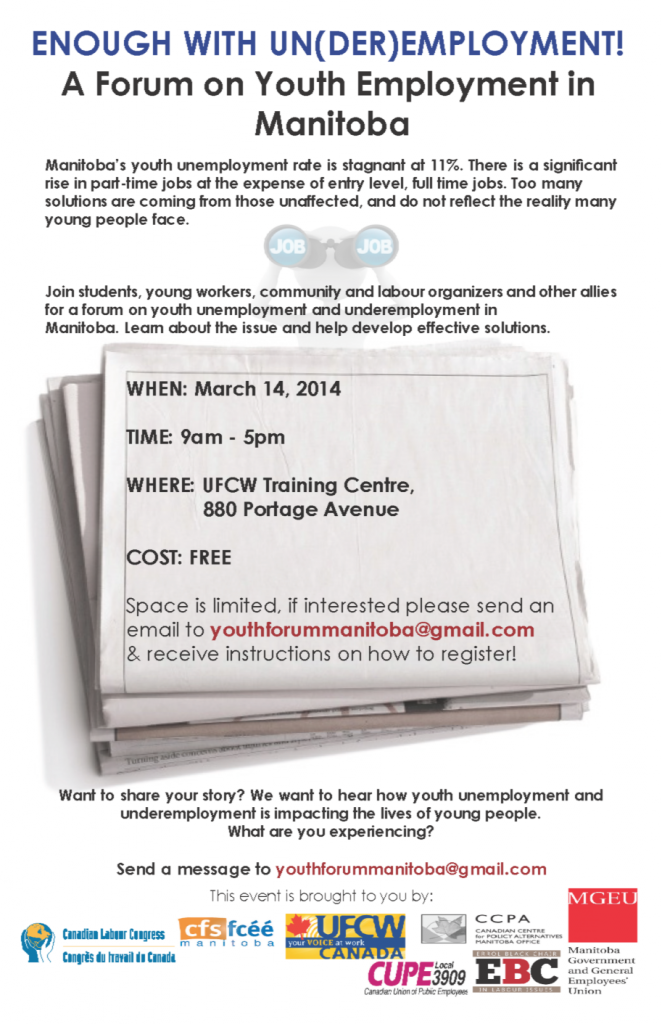
Enough with un(der)employment!: A forum on youth employment in Manitoba


YouthunderemploymentJoin CUPE 3909 and our allies as we discuss the impact of youth unemployment and underemployment on ourselves, our members, and our communities, and help develop a collaborative solution to combat these issues affecting young Manitobans.

Space is limited, so please contact  the organizers ASAP at youthforummanitoba@gmail.com for more information on how to register.

WHEN: MARCH 14, 2014
WHERE: 880 Portage Avene, UFCW Training Centre
TIME: 9:00am-5:00pm
COST: FREE!

Noam Chomsky “On Academic Labour”

Recently, Noam Chomsky deliberated on the problems faced and created by universities.  He spoke about various aspects, including the increase in non tenure track hiring and the perceived need for a “flexible” labour force.  As Sessionals who find themselves in precarious employment situations and Student Academic Workers who expect to graduate into the world of academia, members of CUPE 3909 may find this article interesting.

Read his article here.

RIGHT OF FIRST REFUSAL for SESSIONAL ACADEMIC WORKERS (UNIT 2)

Right of First Refusal is a form of job security.  When a Sessional Instructor has Right of First Refusal over a particular course, (s)he will be given the opportunity to accept or reject an offer for that course.  That course will only be posted and applications considered if the Sessional Instructor with RFR rejects the position.

What is Right of First Refusal 1?

RFR1, is designed to reward a Sessional Instructor who specializes in one or two courses.  S/He must teach the same course five times over a minimum period of 18 months to benefit from prioritized hiring.

What is Right of First Refusal 2?

RFR2 is designed for Sessional Instructors who teach a wide variety of courses.  In order to be eligible for RFR2, a Sessional Instructor must teach a course three times in separate academic terms, but they must also have a total of 30 credit hours and at least 18 months of experience within her/his department.  If you continue working, you will eventually be eligible for RFR1.

What if more than one person has RFR over the same course in my department?

RFR1 will always trump RFR2. If two Sessional Instructors have RFR1 (or RFR2) over the same course, the one with seniority will have the first choice. (S)He may invoke RFR over one section of the course per term.  Then, whoever is next in seniority may invoke RFR over another section.  After all eligible Sessionals have had the chance to invoke their RFR, the remaining sections will be posted.  Any Sessional, including those with RFR may submit an application.

What if I teach courses in different departments?

Right of First Refusal is department specific.  Courses taught in different departments will be calculated separately towards eligibility in each of your departments.

What if I teach the same course in-class and online?

Courses taught online will be counted separately from courses taught in class.  When the University considers your eligibility for either of the RFRs, it should look at both online and in class courses but prioritized hiring will be separate.

What happens if some of my courses are not degree credit courses?

RFR1 and RFR2 only apply to degree credit courses. Non degree credit courses do not count towards eligibility.

Do courses I teach on other campuses count towards Right of First Refusal 2?

The calculation of hours that determine your eligibility will only include degree credit courses taught at Fort Garry and Bannatyne campuses as well as courses taught at off-site locations (The Pas, Thompson, etc.) that are part of the University of Manitoba.  Distance and Online Education courses taught through Extended Ed are eligible, provided that they are degree credit courses, but they are counted separately from in class courses.  Classes taught through the International College of Manitoba, Université de Saint-Boniface, Red River College, University of Winnipeg, Canadian Mennonite University, Booth University College or any other post secondary institution are not eligible.

What if I taught some of my courses while I was working on my degree?

RFR1 and RFR2 only apply to courses taught under the UNIT 2 (Sessional Academic Worker) Collective Agreement.  If you were a registered student when you taught a course, you were hired under the UNIT 1 (Student Academic Worker) Collective Agreement and benefited from a different set of protections called JSP/Continuance.

I co-teach a course.  Can I get RFR on that course?

You may be eligible for RFR on the portion of the course for which you are responsible.

What do I do if all the courses I’ve taught don’t appear in AURORA?

The information that appears in your AURORA account is entered by your home department for each course.  If some of those courses are missing, you should contact your department and ask them to correct the information.  If you work for more than one department, contact all of them.  It is important for you and your Faculty to have an accurate record of your work history so that you can be aware when you are eligible for the new righs/benefits enshrined in the Collective Agreement.

What if I’m not eligible for either form of RFR yet?

Every term, the University will send out a message/letter to every Sessional Instructor who has become eligible for RFR1 or RFR2 at the end of the previous term.  You will be able to invoke RFR when courses are offered in the term subsequent to receiving confirmation.

If you have a question that isn’t answered here, contact us.

SESSIONAL ACADEMIC WORKERS HAVE A NEW COLLECTIVE AGREEMENT

Sessional Academic Workers ratified a new, more transparent and enforceable collective agreement in November 2013.  Most Sessionals received back pay in the last paycheque issued in December 2013 and are now receiving the new rate of pay.  If you did not receive back pay, contact UM Payroll.

Hourly workers have seen an increase in their rate and instructors who are paid by stipend are now receiving $1645.17 per credit hour.  Members who are already paid above the minimum stipend will receive a lump sum payment.

We now have the concept of a performance adjustment for instructors who have taught the same course in three separate terms: $1669.02 per credit hour.  Another new concept is the hourly rate of $27.42 for work which has been assigned by the department but which is not part of the work normally included in the Appointment, including mandatory meetings not related to the Appointment.  Sessional Instructors who are asked to substitute for another employee will be paid at that rate and will be assigned three hours of prep time for every hour they spend in the class.   Employees who are have labs or tutorials in addition to the credit hours of their Appointment will be paid at this rate but the number of hours must be determined by the department.  Distance and Online Instructors who are required to create assignments now have a lump sum payment of $500 for this additional duty.  Music Teachers no longer have to work consecutive terms in order to receive increments.

The original Right of First Refusal, now called RFR1, is now easier to earn and harder to lose.  RFR2 has been created to respond to members who teach a large number and a wide variety of courses.  Instructors who accumulate 30 credit hours and who teach the same degree credit course a minimum of 3 times non-concurrently over a minimum of 18 months are eligible for RFR2 and priority in hiring.  Note, RFR1 trumps RFR2.  If you did not receive a letter in the mail or an email about RFR2 for July 2014, please contact the office.

There have been many more improvements and additions that help clarify the Sessional contract.  Once the Collective Agreement has been finalized, the full document will uploaded onto the website.


Delegate Reports on PSE Task Force & CUPE National Convention

Former CUPE 3909 President Matt McLean was our delegate to the CUPE National Convention held in Quebec City in October, where he also attended the Post Secondary Education Sector meeting as part of his role on the CUPE PSE Task Force. Read his reports on both below.

Report on National Post Secondary Task Force

Over the past two years I have had the pleasure of representing Manitoba on CUPE’s National Post-Secondary Education Task Force. This Task Force was created as a result of a resolution passed at the 2011 National Convention. CUPE members do a wide variety of work in the PSE sector, including academic workers, clerical support, library workers, food service workers, custodians, and virtually every other position held in Colleges and Universities across Canada. In total, CUPE represents over 65,000 workers in the Post Secondary sector. Continue reading

RATIFICATION VOTE!

The Sessional Academic Worker (Unit 2) Bargaining Team is happy to announce that we have concluded the negotiations and reached a tentative agreement.  The Bargaining Committee unanimously has recommended this agreement.  Despite the challenges we had with patterned bargaining at the University this agreement has introduced many new concepts that were never in the agreement before with respect to job security, monetary issues, and other language that protects our members.  This agreement is very transparent, clear, and enforceable.

Voting was held through numerous meetings this week and the members who attended overwhelming supported the agreement. Thank you to the members who came out to vote and who contacted us throughout the process.

We will be sending out full information to all sessional academic workers and are planning  information sessions in the near future for members who would like further explanation of the new collective agreement.

LOCAL UPDATE

The Local is consistently working to resolve issues that we find by reviewing posting and hiring information sent to us by the University.  We send the University a weekly report on mistakes in postings on issues such as wages, job duties, numbers of hours of work, and other working conditions as set out in the posting.  These problems are generally resolved before our members are affected.

Other issues are brought forward by the membership.  Over the past few months we have received numerous calls concerning TA hours of work going over the hours indicated in the contract; members concerned that they did not receive paycheques over 2 or more pay periods; questions about leave of absence rights; about how pension is calculated; and about job security periods and seniority.  The office and the Executive work to resolve issues, answer questions, or direct members to the appropriate U of M office.  We also keep track of the kinds of issues that come in so that we can prevent them from happening in the future.  If you have any problems in your area please contact the office.  We can help.

CCPA ARTICLE on ACADEMIC FREEDOM by Julie Guard

Recently, the Canadian Centre for Policy Alternatives published an article written by UM Labour Studies professor Julie Guard about the importance of Academic Freedom and how it has come under attack at the University of Manitoba and at other post secondary institutions.  The article contextualizes the recent near strike at the U of M, something that was missing from most of the media coverage about UMFA negotiations.

You can read that article here.

Download (PDF, 287KB)

#2 POTENTIAL UMFA (University of Manitoba Faculty Association) Strike

This letter was sent to the email addresses for CUPE members as provided to us by the University.  If you did not receive this email, please contact us immediately.

Last week we sent you a newsletter regarding a potential UMFA strike.  UMFA  has set a strike deadline of midnight Monday, October 21st meaning that they could be on strike as of Tuesday morning.  In our last newsletter we outlined our understanding of the issues behind the strike and stressed that money is not the issue, but rather faculty concerns around academic freedom and related issues.  We also stated that we support UMFA in this important struggle.

We have met with UMFA and other labour unions on campus (UNIFOR and AESES) regarding how we are all going to demonstrate support for the strike.  We also raised all of the questions that you sent us with the Human Relations Officer for CUPE 3909.   As of this date, this is the information we can forward to you.

How will this strike affect you?

Different groups will be affected in different ways.  As we stated in our last newsletter, Manitoba Labour Law does not protect our members if they refuse to cross the picket line.  By refusing to cross, we could be deemed to be in violation of our employment contract.  All communications from the University to the Union and to our members via the University website confirm that this will be the position of the University Administration.

The Local Union is very concerned about the situation and we want to assist you in navigating the difficulties that you may face in the days ahead.

How are CUPE Instructors affected specifically?

CUPE 3909 Unit 2 Sessional Instructors and Unit 1 Student Instructors are expected to report to work and do their jobs.  Instructors are not permitted to change the time of courses or move the courses to an off-campus location.

What does this mean with respect to students who choose not to cross the picket lines?

Two very different messages are being sent to students.

UMFA and others are informing students that the Manitoba Human Rights Act states that individuals cannot face discrimination on the basis of their political activity.  UMFA’s Open Letter to Students states: “Therefore, students who refuse to cross picket lines must be accommodated and cannot be subject to academic penalty or disadvantage.”

The University message is less clear.  They tell students: “A strike will not affect your academic record, work placements or co-op programs.”  However they go to on to say: “Plan to attend your classes as usual, as we don’t know yet what effect a strike will have on class schedules, mid-term exams or final papers.”  They also advise that “If students choose not to cross the picket line, they are responsible for materials covered in any class or lab.”

Our CUPE Instructors are in a very difficult position.  We suggest that you ask your Department Head/Dean/Director how to respect the rights of students who do not cross the picket line without putting your employment contract in jeopardy.

How are Teaching Assistants and Grader Markers affected specifically?

Our CUPE Student members are also in a difficult position.  In their role as students, they do not have to cross the picket line, but as Teaching Assistants and Grader Markers they are required to report to work and do their job.  Depending on your job and your supervisor, there may or may not be work for you.  Unfortunately there is no guarantee of hours for TAs and Grader Markers under these circumstances so you may lose hours due to the strike.  However, you may have the opportunity to extend your appointment and/or make up hours when the strike ends.

CUPE Librarians and Counsellors will also be required to report to work and perform their duties for the duration of the strike.

Will CUPE members be required to perform UMFA work?

CUPE members should not be performing the work of striking UMFA faculty.  The University might approach you to do some of this work but it is important for you to know that you are legally protected if you refuse.  We have been given assurances from Administration that our members will not be pressured into performing UMFA work and will not be penalized if they refuse such work.

How can we support the striking UMFA members?

UMFA has asked us to be friendly when we cross the picket line, take their material, ask them any questions we may have, and express our support.  They have also invited us to join their picket line when we are not working.  Along with the other campus labour Unions, we will be distributing “IN SUPPORT” buttons, which you will receive in the mail.  We are asking that you wear these during the strike.

Your Union will remain available to assist you and to answer any other questions that you may have during the strike.  Please contact us at cupe3909@gmail.com or telephone the office at 204-453-5493.  If your matter is urgent please call 204-250-8697.